
 WORKSHEET B2-C1
KIMCHI, CULTURE, AND CONTROVERSY
Part 1. Warm-up
- Why do you think food can become a symbol of national identity?
- Can food ever cause political or cultural conflict?
- What traditional dish represents your country best?
- Should international organizations decide what counts as “authentic” food?
Part 2. Vocabulary focus
Part 3. Reading – Kimchi, Culture, and Controversy
For much of its early history, the Korean Peninsula was divided into several competing kingdoms. Around 1,300 years ago, these territories were unified under the Shilla kingdom, marking the beginning of a more centralized Korean state. Later, power passed to the Koryo kingdom, followed by the Chosun dynasty, which ruled the peninsula for nearly 500 years. Many key elements of modern Korean society — including language, social values, and culinary traditions — developed during the Chosun period. Even today, the name “Korea” reflects this history, as it originates from the earlier Koryo kingdom.
In the modern era, however, the peninsula is divided into two separate states: North Korea and South Korea. This division became official in 1948, shortly after the end of the Second World War. While the two countries share a common cultural and historical background, their political systems and international relationships differ greatly. Despite these differences, certain cultural traditions continue to play a central role in Korean cultural identity. One of the most important of these traditions is kimchi.
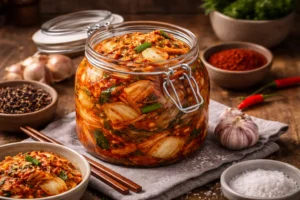
Kimchi is a fermented dish typically made from cabbage or radish, combined with garlic, chili peppers, salt, and other seasonings. It is known for its spicy flavor and pungent smell. Traditionally served as a side dish, kimchi appears at almost every Korean meal. In South Korea, over 90% of the population eats kimchi at least once a day, and many people consume it with every meal. Each year, approximately two million tons of kimchi are eaten nationwide. In recent decades, kimchi has also gained popularity in Europe and North America, where it is widely available in supermarkets.
Beyond its role as food, kimchi represents a social tradition. Each year, usually in November or December, families take part in kimjang, the communal preparation of large quantities of kimchi for the winter months. In the past, kimchi was stored in large clay pots buried underground, which helped control temperature and supported fermentation. Although modern households now use special kimchi refrigerators, the cultural meaning of kimjang has remained strong. It is still seen as a time for cooperation, shared labor, and the passing of traditions between generations.
In recent years, kimchi became the center of an international controversy involving China and South Korea. A Chinese, state-controlled newspaper called The Global Times published an article claiming that China had established an international standard for kimchi production. The article suggested that China was leading the global kimchi industry, a claim that angered many South Koreans. Critics argued that the article blurred the line between kimchi and pao cai, a fermented vegetable dish from China’s Sichuan province.
South Korean officials quickly responded to the article, stating that the certification mentioned referred specifically to pao cai, not kimchi. They emphasized that while both dishes are fermented, they differ significantly in ingredients, preparation methods, and cultural meaning. Furthermore, South Korean authorities pointed out that international standards for Korean kimchi had already been recognized by the Food and Agriculture Organization (FAO) nearly twenty years earlier.
The controversy sparked strong reactions in South Korea. Several newspapers mocked the Chinese article, describing it as an attempt to claim ownership over another nation’s tradition. On social media, some users even called for a boycott of Chinese-made goods. Although these reactions were emotional, they highlighted a deeper issue: the importance of food as a symbol of national pride and cultural ownership.
International organizations also play a role in this discussion. UNESCO, a branch of the United Nations, maintains a list of Intangible Cultural Heritage — traditions and practices that are not physical objects but are considered vital to cultural identity. In 2013, UNESCO added kimjang, the traditional preparation of kimchi, to this list. This recognition confirmed that kimchi is not merely a product but a living cultural practice that deserves protection.
The dispute over kimchi demonstrates how food can move beyond the kitchen and become part of political debate, media conflict, and international relations. In an increasingly globalized world, questions of ownership, authenticity, and cultural recognition are becoming more common. The kimchi controversy shows that even something as everyday as a side dish can carry deep historical meaning and continue to shape national identity in the modern era.