
 WORKSHEET B2-C1
JELLYFISH
Part 1. Warm-up
- Have you ever seen a jellyfish in the sea or in an aquarium? What did it look like?
- How do you think animals move in the ocean without legs?
- How do you think jellyfish have survived for hundreds of millions of years?
Part 2. Vocabulary focus
Part 3. Reading – Jellyfish
Jellyfish, often simply called “jellies,” move through the ocean mainly by drifting with currents and tides. However, they are not completely passive organisms. Many species are capable of active swimming and can control their movement in the water.
Some jellyfish, such as comb jellies, move using tiny hair-like structures along the edges of their bodies. These structures are called cilia. They move rhythmically back and forth, allowing the animal to propel itself forward. In effect, comb jellies “row” through the water in a coordinated motion.
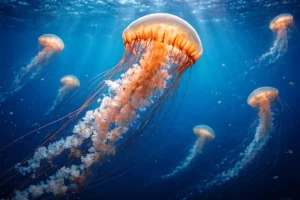
Most jellyfish, however, have a bell-shaped body that resembles an umbrella. These animals move by repeatedly expanding and contracting this bell. When the bell contracts, water is pushed out from underneath the body. This action propels the jellyfish forward through the surrounding water.
Marine researchers from a university in the United States recently studied the swimming behaviour of moon jellyfish. Their research revealed a surprising mechanism that explains how these animals move so efficiently.
The scientists discovered that moon jellyfish create a temporary “wall” of water beneath their bodies when they pulsate. After producing this stationary layer of water, the jellyfish push against it to move forward. The researchers believe that this technique allows moon jellyfish to swim with remarkable energy efficiency. In fact, this species may be one of the most energy-efficient swimmers in the animal kingdom.
There are thousands of species of jellyfish in the world’s oceans. Despite their name, they are not actually fish. For this reason, scientists often prefer the simpler term “jellies.” Most jellyfish live in saltwater, although a small number of species inhabit freshwater environments.
Jellyfish are also extremely ancient organisms. Fossils of jellyfish have been discovered in rocks that are more than 500 million years old. This means that jellyfish existed in the world’s oceans long before animals began to live on land.
Most jellyfish have long tentacles that extend from beneath their bodies. These tentacles play a key role in feeding. The mouth of a jellyfish is located on the underside of its body, usually in the center.
Depending on their size and species, jellyfish feed on a variety of marine organisms. Their diet often includes plankton, small crustaceans, larvae, fish eggs, algae, and even other jellyfish. Larger species may also capture small fish.
One of the most unusual features of jellyfish is their simple body structure. They do not have a brain, heart, or blood. Many species are almost completely transparent, allowing light to pass through their bodies. In fact, jellyfish are composed of at least 90 percent water.
Their tentacles contain specialized cells that produce toxins. These toxins help the jellyfish capture prey by stunning or killing it. Although most jellyfish are harmless to humans, the stings of some species can be painful and may require medical treatment.
Relatively few marine animals prey on jellyfish. However, sea turtles and sunfish are known to feed on them. When large numbers of jellyfish gather together, they form what scientists call a bloom. Some blooms may contain over 100,000 individuals.
Moon jellyfish, sometimes called common jellyfish, are among the most widespread species in the world. They can be found in many oceans and coastal waters. Their bell-shaped bodies usually measure between 25 and 40 centimeters in diameter.
Blooms of moon jellyfish often appear during the summer months. Individual jellyfish usually live for about six months.
To better understand their movement, researchers filmed several moon jellyfish swimming in a laboratory tank. They used a high-speed digital camera to capture the details of their motion. The tank was filled with tiny illuminated glass beads. These beads allowed scientists to observe the flow of water around the jellyfish as they swam.
Animals that live on land typically move by pushing their legs against the ground. The ground remains stationary, allowing the force of the movement to propel the animal forward. Some marine animals that live near the seabed use a similar method. They push water downward so that the water pushes against the seabed.
However, jellyfish that live in the open ocean do not have a solid surface to push against.
By slowing down their recordings, the researchers observed that moon jellyfish temporarily create a small region of still water beneath their bodies. Although this region exists for only a brief moment, it acts as a surface that the jellyfish can push against.
The process involves the formation of two spinning rings of water known as vortices. These rings resemble the shape of a donut. One vortex forms beneath the jellyfish’s body, while the second rotates in the opposite direction.
When the two vortices interact, they create a circular region of stationary water. This temporary “water wall” allows the jellyfish to push forward in the same way that other animals push against solid surfaces.
Although the water wall exists only briefly, a new one forms each time the jellyfish contracts its bell.
The researchers conducted their experiments using moon jellyfish, but it is likely that other bell-shaped jellyfish swim in a similar way. Unlike propellers used by boats, jellyfish move silently and do not create bubbles as they swim.
Because of this quiet and efficient movement, scientists believe that jellyfish could inspire new designs for underwater robots. In the future, engineers may develop robotic vehicles that move through water using a jellyfish-like propulsion system.
Part 4. Reading Comprehension True or False?
Part 5. Use of English