
 WORKSHEET B1-B2
THE MYSTERY OF MOVILE CAVE
Part 1. Warm-up
- Have you ever heard about animals living in extreme environments (for example, deep underwater or underground)? What do you know about them?
- How do you think animals survive in places with no sunlight or fresh air?
- Why is it important for scientists to investigate unusual ecosystems?
- Do you think humans should explore dangerous natural places? Why or why not?
Part 2. Vocabulary focus
Part 3. Vocabulary 2 Phrasal Verbs
Part 4. Reading – The Mystery of Movile Cave
Movile Cave is located in Romania, not far from the Black Sea coast. It was discovered in 1986 by workers who were investigating a possible site for a new power station. At first, the cave did not seem unusual. However, as scientists began to explore it, they realized that something about it simply did not add up.
The cave lies about 20 meters below the surface. The entrance is a narrow vertical shaft that leads down into a network of tight passageways. These eventually open into a larger underground cavern containing a lake. Fewer than one hundred people have ever entered Movile Cave, mainly because the air inside is extremely dangerous. It contains very little oxygen and high levels of toxic gases such as carbon dioxide, methane, ammonia, and hydrogen sulfide. Only researchers wearing special breathing equipment can safely go inside.
Under normal conditions, such an environment would not support life. That is why scientists were surprised to discover that the cave is home to a unique and thriving ecosystem. More than fifty species of invertebrates — animals without backbones — live there. These include worms, spiders, water scorpions, leeches, and tiny shrimps. Even more remarkable is the fact that many of these species exist nowhere else in the world.
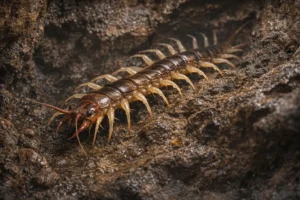
Recently, researchers identified a new species inside the cave: a type of centipede. Centipedes are ancient creatures, with fossil evidence dating back over 400 million years. Today, there are more than 8,000 known species worldwide. They are usually found in dark, damp places such as under rocks or inside rotting wood. However, none are normally associated with such extreme underground conditions.
The newly discovered centipede, named Cryptops speleorex, which means “king of the cave”, appears to be the top predator in Movile’s ecosystem. It feeds on other cave-dwelling creatures and has adapted to survive in total darkness and toxic air. Scientists believe that millions of years ago, some centipedes may have fallen into the cave. Over time, natural selection allowed them to evolve and survive in isolation.
What makes Movile Cave so extraordinary is its food chain. In most ecosystems, plants use sunlight to produce energy through photosynthesis. Animals then eat plants or other animals. But Movile Cave has been completely cut off from sunlight for millions of years. No plant life exists there, and no water from the surface brings in nutrients.
Instead, the ecosystem depends on bacteria. These bacteria use a process called chemosynthesis. Rather than relying on sunlight, they obtain energy from chemical reactions involving sulfur, methane, and ammonia. The bacteria form a thin layer on the surface of the lake water, which looks like wet tissue paper. Small creatures feed on this bacterial layer, and larger predators — including the centipede — feed on them.
When the cave was first studied, some scientists were so amazed that they even asked colleagues over to examine the site themselves. Many researchers could hardly believe the results. An ecosystem that functions entirely without sunlight challenges traditional ideas about how life survives on Earth. Some experts even suggested that similar systems might exist on other planets or moons.
However, the discovery also raised important questions. How could such a complex ecosystem develop in such isolation? And who would answer for the environmental risks if the area were disturbed by human activity? Since the cave was discovered during plans for industrial development, concerns about protecting the site quickly emerged.
Today, access to Movile Cave is strictly controlled. Scientists continue to study it carefully, knowing that even small changes could disrupt its fragile balance. The existence of such a rare ecosystem forces us to reconsider what we think we know about life on Earth.
In the end, Movile Cave teaches us an important lesson: even in the most hostile and isolated environments, life can find a way to survive. What once seemed impossible now adds up to a powerful example of adaptation and evolution.
Part 5. Reading Comprehension – True or False?
Part 6. Use of English