
 WORKSHEET B1-B2
THE AFRICAN CRESTED RAT
Part 1. Warm-up
- Do you know any animals that use poison or venom to protect themselves?
- Would you expect a small animal like a rat to be dangerous? Why or why not?
- Is poison a better defense than speed or strength?
Part 2. Vocabulary focus
Part 3. Reading – The African Crested Rat
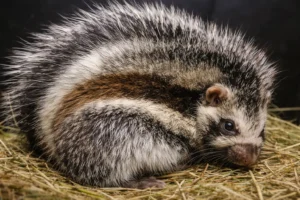
At first glance, the African crested rat looks like an ordinary animal. It is about the size of a rabbit and lives in parts of East Africa, including Kenya, Uganda, and Tanzania. However, this rodent has one extraordinary feature that makes it unique among mammals: it is the only known rodent in the world that uses poison as a defense.
Like all rodents, the African crested rat has strong front teeth that never stop growing. To keep them short, the animal must gnaw on hard materials such as wood. Its diet mainly consists of leaves, fruit, and plant material. The rat’s thick fur is another important feature. Long black-and-silver hairs cover a softer gray undercoat, giving the animal a striking appearance.
When the rat feels threatened, it does not immediately run away. Instead, it raises its long outer hairs, revealing special brownish patches on each side of its body. These hairs are not ordinary fur. They have a sponge-like structure that can absorb liquid. Inside these hairs, the rat stores poison that can seriously harm predators.
The poison does not come from the rat’s own body. Scientists discovered that crested rats chew the bark of a plant known as the poison arrow tree. For centuries, people in the region used poison from this tree on hunting arrows. After chewing the bark, the rat mixes the poison with its saliva and then licks the special hairs on its sides. The hairs absorb the poison, creating a powerful defense mechanism.
If a predator such as a dog, jackal, or hyena bites the rat, the poison enters the predator’s mouth. In some cases, this can kill the attacker. In other cases, it causes severe illness, teaching the predator to avoid the crested rat in the future. Interestingly, the poison does not affect the rat itself.
Scientists wanted to understand how the rats survive such a strong poison. They found that crested rats have unusually large stomachs divided into several chambers. These chambers contain large amounts of bacteria. Researchers believe that some of these bacteria help break down the poison before it can harm the rat.
For many years, scientists believed that crested rats were solitary animals. Recent research suggests that this is not always true. In controlled environments, male and female rats often spent long periods together, suggesting monogamous behavior. The rats also communicate using soft sounds such as squeaks.
The African crested rat shows how animals can develop highly specialized ways to survive in dangerous environments. Although poison protects the rat from many predators, birds of prey may still attack it from above using their claws instead of their teeth. This shows that even the most effective defence systems have limits in the constant struggle between predators and prey.