
 WORKSHEET B1-B2
ELECTRIC EELS
Part 1. Warm-up
- What do you know about electric animals? Can you name any?
- Why do you think some animals use electricity?
- Do you think animals can work together when hunting? Why / why not?
Part 2. Vocabulary focus
Part 3. Reading – Electric Eels
Electric eels live in the Amazon and Orinoco River basins in South America. Most of these areas are located in Brazil. These fish are usually found in muddy, slow-moving water, such as shallow rivers, lakes, swamps, and creeks. The environment is often low in oxygen, which makes it difficult for many animals to survive.
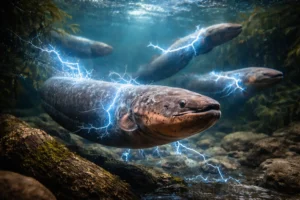
For a long time, scientists believed that electric eels were solitary animals. This means they lived and hunted alone. Electric eels can produce electricity, which they use to stun or kill their prey. However, recent research has shown something surprising. A team of Brazilian scientists recorded electric eels hunting together in groups. This kind of behavior had never been observed before.
Despite their name, electric eels are not actually eels. They belong to a group of fish called knifefish. Until recently, scientists thought there was only one species of electric eel. However, after analyzing DNA from eels found in different regions, researchers discovered that there are actually three species. These species look very similar, but they differ in how much electricity they can generate.
Around 500 species of fish can produce electricity, but most of them generate only a small amount. Electric eels, on the other hand, are extremely powerful. The strongest ones can produce up to 860 volts. For comparison, standard electrical outlets in Europe provide around 220 to 240 volts, while those in North America provide about 120 volts.
Unlike most fish, electric eels breathe air. While other fish use their gills to take oxygen from the water, electric eels must regularly swim to the surface to breathe. They usually do this every ten minutes. This is necessary because the water in their habitat contains very little oxygen.
Adult electric eels can grow up to 2.3 meters in length. Females are typically larger than males. Their bodies can be different colors, including gray, brown, blue, or black. Although they have poor eyesight, they have very good hearing, which helps them detect movement in the water.
Electric eels have three special organs that produce electricity. These organs make up most of their bodies and contain thousands of specialized cells that work like tiny batteries. Because their bodies are insulated, electric eels do not shock themselves.
Electric eels use electricity in several different ways. Some electric pulses are used for navigation, a process called electrolocation. This helps them find objects and animals in dark or muddy water. If a nearby fish does not move, the eel may not notice it. In such cases, the eel sends out small electric signals that force the fish to move. Once the fish moves, the eel can detect its location.
Electric eels can also produce strong electric shocks to attack prey or defend themselves. Smaller animals can be killed instantly. Larger animals, including humans, can be stunned by the shock and may drown if they are in the water. In rare cases, the shock may even cause a heart attack, especially in people with existing health problems.
The most powerful species of electric eel is known as Volta’s electric eel (Electrophorus voltai). It was named after Alessandro Volta, an Italian scientist who invented the battery.
Scientists have recently discovered that these eels sometimes hunt in groups. During the day, they rest in deeper water. At dusk and dawn, they gather in groups of around 100 individuals. They swim in circles to trap smaller fish in shallow water. Then, a smaller group of eels produces a coordinated electric attack. The shock causes some fish to jump out of the water, while others are stunned. The group then feeds on the trapped fish.
Group hunting is very rare among fish, which makes this discovery especially interesting. So far, this behavior has only been observed in one location. However, scientists believe it may occur in other parts of the Amazon, especially in areas with large numbers of smaller fish. Many regions where electric eels live have not yet been fully explored, so there is still much to learn about these fascinating animals.
Part 4. Reading Comprehension
Part 5. Vocabulary – Gap-fill