
 WORKSHEET A2-B1
YELLOWSTONE NATIONAL PARK
Part 1. Warm-up
- Have you ever heard about Yellowstone National Park? What do you know about it?
- Why do you think people visit national parks?
- Have you ever seen a geyser or a volcano in real life or in a video? What happened?
Part 2. Vocabulary focus
Part 3. Reading – Yellowstone National Park
Yellowstone National Park is in the United States. It was created in 1872 and many people believe it was the first national park in the world. The park is very large. Most of it is in the state of Wyoming, but parts of the park also extend into Idaho and Montana.
Yellowstone is famous for its wildlife and beautiful natural landscapes. Large groups of bison and elk live in the park. Visitors can also see animals such as wolves and grizzly bears. Every year, about four million people visit Yellowstone to see its nature and unique geological features.
Much of the park lies above a geological hotspot deep underground. A hotspot is an area where very hot rock called magma exists below the Earth’s surface. Magma is extremely hot melted rock. Because of this hotspot, Yellowstone experiences volcanic activity and small earthquakes from time to time.
Sometimes the ground in Yellowstone slowly rises or sinks. This happens because pressure builds up in the magma chamber deep underground. Scientists carefully monitor these movements to better understand what is happening beneath the park.
One of the most interesting geological features in Yellowstone is the Yellowstone Caldera. A caldera is a large bowl-shaped area that forms after a huge volcanic eruption. When a volcano erupts and empties a large magma chamber underground, the ground above it can collapse.
Scientists believe that several massive eruptions created the Yellowstone Caldera. The most recent eruption happened about 640,000 years ago. Earlier eruptions occurred about 1.3 million and 2.1 million years ago.
Because of its size, the Yellowstone Caldera is sometimes called a supervolcano. A supervolcano is much larger than a normal volcano. If it erupts, it can send huge amounts of ash into the atmosphere and affect the climate across large parts of the world.
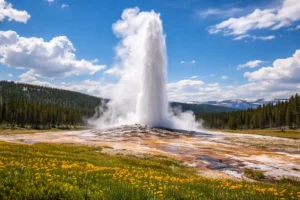
Yellowstone is also famous for its geysers. A geyser is a special type of hot spring that shoots hot water and steam into the air. Geysers usually appear in volcanic areas where underground water is heated by magma.
There are about 1,000 geysers in the world, and around half of them are located in Yellowstone. The park’s most famous geyser is called Old Faithful. It received this name because its eruptions happen regularly and are easier to predict than most geysers.
Old Faithful usually erupts every 45 minutes to two hours. When it erupts, hot water can reach a height of about 56 meters. The eruption usually lasts between one and five minutes.
Another well-known geyser in the park is called Steamboat Geyser. It is currently the tallest active geyser in the world. When it erupts, it can shoot boiling water up to 91 meters into the air.
Steamboat Geyser does not erupt regularly. Sometimes many years pass without an eruption. For example, it did not erupt between 1911 and 1961. It also stopped erupting for several years between 2005 and 2013.
Since 2018, however, Steamboat has become more active again. In recent years, it erupted more than 40 times in one year. Scientists began studying the geyser more closely to understand why this happened.
Researchers measured underground temperatures, earth tremors, and the heat released by the geyser. They also studied the water that came out during eruptions. Their research showed that the increased activity was probably connected to natural changes in underground water systems.
Some people worried that the increased activity of Steamboat might mean a huge volcanic eruption was coming. However, scientists say that there is no evidence that a supervolcano eruption will happen soon.
Yellowstone remains one of the most fascinating national parks in the world. Scientists continue to study its geysers, earthquakes, and underground activity to better understand how this unique natural system works.
Part 4. Reading Comprehension
Part 5. Vocabulary – Gap-fill