
 WORKSHEET A2-A2+
POMPEII – A CITY UNDER ASH
Part 1. Warm-up
- Do you know any famous cities from the past? Which one?
- Have you ever heard about Pompeii before reading this text?
- What do you think people do when a natural disaster happens?
- Would you like to live near a volcano? Why or why not?
Part 2. Vocabulary
Part 3. Reading – Pompeii
Pompeii was an ancient Roman city in Italy, and it was near the modern city of Naples. Almost 2,000 years ago, many people lived in Pompeii, so it was a busy and lively place. The city had busy streets, small shops, and nice houses. There were also temples, public baths, fountains, and a big theater. Rich Romans liked to visit Pompeii because it was close to the sea and the weather was often warm.
There is a volcano near Pompeii called Mount Vesuvius. For a very long time, people did not think the volcano was dangerous, so they lived their lives without fear. It was quiet, and life in the city felt normal. People worked during the day, and they bought food in the market. In the evenings, they met friends, cooked meals, and went to public baths. Some rich people had beautiful wall paintings in their homes, and some homes even had water pipes and running water.
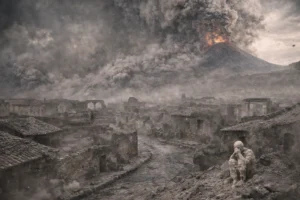
In the year 79 CE, everything changed when Mount Vesuvius erupted. At first, ash and small stones fell from the sky, and the air became dark. The streets became dirty, so people were scared. Many tried to escape, and some ran out of the city toward the coast because they thought it was safer there.
However, not everyone left Pompeii. About 2,000 people stayed in the city. Some people stayed because they wanted to protect their homes, while others did not know what to do. Some people could not leave fast, so they remained in the city. As time passed, there was more ash in the air, and breathing became difficult. The city became quieter, and the streets were almost empty.
Later, very hot clouds of ash and gas came down from the volcano. They moved very fast, and they were deadly. People did not have time to escape, so everyone who stayed in the city died. Many people who tried to escape also died. The eruption destroyed Pompeii, the nearby town of Herculaneum, and several villages.
After the eruption, Pompeii was covered by ash, and the city disappeared under the ground. People left the area, and no one rebuilt Pompeii. Over time, people forgot where the city was, and hundreds of years passed while Pompeii stayed hidden.
In 1738, workers discovered Pompeii by accident while they were building a palace for the King of Naples. They found old walls and stones, so scientists and workers began to dig carefully. They wanted to discover more about the ancient city, and over many years they uncovered streets, houses, shops, and public buildings. Today, work still continues in some areas.
The ash helped to protect many things. Because of the ash, parts of Pompeii stayed in good condition. Scientists found wall paintings, tools, dishes, and other everyday objects. They also found water pipes and parts of an aqueduct system. Thanks to Pompeii, we can understand daily life in Roman times and see what people ate, where they worked, and how they lived.
Scientists also found something very sad. In the hard ash, they found empty spaces, which were left by people who died in the eruption. Long ago, researchers filled these spaces with plaster, and when the plaster became hard, it made a clear outline of a human body. Today, scientists often use a clear material instead of plaster, but the idea is the same. The outlines show real people in their last moments.
Recently, researchers found two new outlines in a large house outside the city. They believe one man was rich and the other was his slave. The younger man did hard physical work, while the older man probably lived in the villa. Both men died during the eruption, and these discoveries help scientists learn more about life in Pompeii and about social roles in Roman times.
Today, Pompeii is a famous tourist place, so millions of visitors come every year. A visitor can walk on the old streets and see the buildings, and people can also visit Herculaneum nearby. Mount Vesuvius is still an active volcano today, and many people live near it, so the story of Pompeii is still an important warning about nature and danger.