
 WORKSHEET B1-B2
SEADRAGONS
Part 1. Warm-up
- Have you ever seen an animal that was very hard to notice because it looked like its surroundings?
- Why do you think camouflage is important for animals living in the ocean?
- Do you think animals living in one area can change over time? Why or why not?
Part 2. Vocabulary focus
Part 3. Reading – Seadragons
Seadragons are some of the most unusual and visually striking creatures found in the ocean. These small marine animals live mainly along the southern coast of Australia, where the water is relatively shallow and rich in sea plants. Although they look very different from most fish, seadragons are closely related to seahorses and pipefish. Like their relatives, they move slowly, rely heavily on camouflage, and have developed highly specialized bodies that help them survive in their natural environment.
For a long time, scientists believed that there were only two species of seadragons: the common seadragon, also known as the weedy seadragon, and the leafy seadragon. Both species are well known for their strange appearance and their ability to blend into their surroundings. However, a few years ago, researchers identified a third species living in deeper waters. This species was named the ruby seadragon because of its deep red color. Its discovery showed that there is still much to learn about marine life, even in areas that scientists have studied for many years.
Recently, researchers at an Australian university have been studying the common seadragon in more detail. Using modern gene-sequencing technology, they analyzed the animals’ DNA to better understand how different populations are related to one another. Their findings suggest that common seadragons are not a single, uniform group. Instead, they can be divided into four genetic clusters, each living in a different coastal region. These groups are genetically similar, but they also show small differences in body shape and structure.
In terms of size, leafy and ruby seadragons usually grow to about 22 centimeters in length. Common seadragons are much larger and can reach almost twice that size. All seadragons share a similar body plan: they have a long snout, a horse-shaped head, and jaws that are fused together. This snout works like a straw. Seadragons do not bite or chew their food. Instead, they suck in very small organisms such as tiny shrimp and sea lice that float in the water around them.
Unlike seahorses, which swim in an upright position, seadragons move through the water horizontally. They are not strong swimmers and rely on small fins to move slowly and carefully. Because of this, they do not travel far from where they are born. In fact, most seadragons spend their entire lives within a few hundred meters of their birthplace. This limited movement helps explain why separate populations develop unique genetic features over time.
Reproduction in seadragons is also unusual. The female lays her eggs on the underside of the male’s tail, where there is a special area called a brood patch. This patch contains small cup-like structures that hold the eggs in place. The male fertilizes the eggs, and they remain attached to his body until they hatch. This role reversal, where the male carries the eggs, is another trait shared with seahorses.
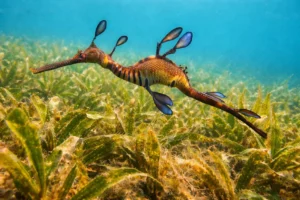
Leafy seadragons are especially famous for their appearance. Their bodies are covered in long, leaf-like protrusions that look almost exactly like seaweed. These appendages move gently with the water, making the animal extremely difficult to see. Leafy seadragons can also change color, shifting between brown and yellow tones depending on their surroundings. When they swim among kelp forests, they are nearly invisible to predators.
Common seadragons have fewer appendages but are often more colorful. They may be red, green, or orange, with bright spots and stripes. These patterns help them blend into seagrass beds, where light and shadow create a complex background. Ruby seadragons, on the other hand, live deeper in the ocean and lack the long protrusions seen in other species. Their red coloring helps them blend into low-light environments, where red light does not travel well through water.
One important difference between ruby seadragons and the other species is their tail. Ruby seadragons have a tail that can curl and hold onto objects, much like a seahorse’s tail. This feature is not found in common or leafy seadragons and may help ruby seadragons stay stable in deeper, moving water.
Australia’s coastline is divided among several states, including New South Wales, Victoria, Tasmania, South Australia, and Western Australia. The researchers found that the four genetic clusters of common seadragons closely match these coastal regions. In particular, seadragons living in Victoria appear to be noticeably different from those found in New South Wales or Tasmania. Scientists now suspect that the Victorian population may eventually be classified as a separate subspecies, as these seadragons do not interbreed with others.
The study of seadragons highlights how geography, limited movement, and environmental conditions can shape the evolution of a species. It also reminds us that even well-known animals can still hold secrets. As research continues, scientists hope to learn more about how these remarkable creatures adapt to their environment – and how best to protect them in a changing ocean.