
 WORKSHEET A2-B1
DAVID AND GOLIATH
Part 1. Warm-up
- Do you know any stories where a weak person defeats a much stronger one?
- Why do you think people still remember ancient stories today?
- Can stories from the past influence how we speak or think today? How?
- Do you think historical stories are always true, or can they include exaggeration? Why?
Part 2. Vocabulary focus
Part 3. Reading – David and Goliath
The Christian Bible is divided into two main parts: the Old Testament and the New Testament. The Old Testament covers a long period of history, spanning roughly 3,000 years, while the New Testament focuses on the life of Jesus Christ and events that took place over about 35 years. The Old Testament is closely connected to the Tanakh, also known as the Hebrew Bible, and many of its stories play an important role not only in religion but also in history, language, and culture.
One of the most famous stories in the Old Testament is the story of David and Goliath. It tells of a young boy named David, who later becomes king of Israel and Judea, and a powerful warrior named Goliath. Goliath is described as a giant, and the Bible states that he was “four cubits and a span” tall, which equals about 7.8 feet (2.38 meters). Many modern readers question this measurement, believing that such a height would be extremely rare and possibly exaggerated.
Goliath was a soldier in the Philistine army. The Philistines were a warlike people who lived along the coast of what is now modern-day Israel. Ancient Egyptian records mention a group known as the “Sea People,” and many historians believe these people were the Philistines referred to in the Bible. Although the Philistines disappeared long ago, their name has survived through history. In fact, the word Palestine comes from the name Philistine, showing how deeply the group influenced the region’s history.
Archaeologists and researchers in Israel have been studying several ancient Philistine sites, including the city of Gath, which is believed to be Goliath’s hometown. At these sites, researchers measured the thickness of city walls and gateways. Interestingly, some of these walls were “four cubits and a span” thick—the same measurement used to describe Goliath’s height. Because of this, historians suggest that the description of Goliath may not have been meant as a literal measurement, but rather as a metaphor. In other words, Goliath may have been described as being “as big as the walls of a Philistine city” to emphasize his power and fearsome reputation.
Most historians agree that David was a real historical figure who lived about 3,000 years ago. According to the Old Testament, Saul was the first king of Israel, and David was originally a young shepherd. He protected his sheep using a sling, a simple weapon that could throw stones at high speed over long distances. David was also known for his musical talent. He played the harp and is traditionally credited with writing many religious songs and poems.
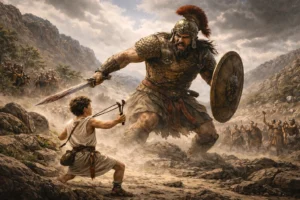
The famous battle takes place during a war between Israel and the Philistines. Goliath challenges the Israelite army to send out a champion to fight him in single combat, with the outcome deciding the war. At this time, David is not a soldier. He is bringing food to his older brothers, who are serving in the army. When David hears Goliath’s challenge, he volunteers to fight him.
King Saul reluctantly agrees and offers David his armor, but David refuses because it is too heavy and unfamiliar. Instead, David goes to face Goliath carrying only a staff and five small stones for his sling. When the two meet, David throws a stone that strikes Goliath on the forehead, knocking him to the ground. David then uses Goliath’s own sword to kill him. Seeing their champion defeated, the Philistine army panics and flees.
After Saul later dies in battle, David eventually becomes king – first of Judea, and later of all Israel. He rules for many years, has many wives and children, and is succeeded by his son Solomon. Solomon is remembered for building the great Jewish temple in Jerusalem, one of the most important religious structures in history.
Today, the phrase “David and Goliath” is commonly used in English to describe a situation where a smaller, weaker person or group faces a much stronger opponent. The word Philistine has also taken on a new meaning, often used to describe someone who is uncultured or uninterested in art and learning.