
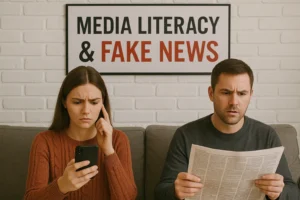
 WORKSHEET B2-C1
MEDIA LITERACY & FAKE NEWS
Part 1. Warm-up
- How often do you read or watch news online?
- What makes a source reliable in your opinion?
- Have you ever believed a piece of information that later turned out to be false?
- Why do you think misinformation spreads so quickly?
Part 2. Vocabulary focus – Match the terms and definitions
Part 3. Reading – How fake news travels faster than truth
In the digital age, information spreads faster than at any other point in history. While this speed allows people to learn and connect in valuable ways, it also creates a perfect environment for misinformation to circulate. False stories often outperform factual ones online, and researchers have been trying to understand why this happens so consistently.
One explanation is emotional impact. Studies have shown that fabricated stories often evoke strong feelings such as fear, anger, or shock. When users experience an immediate emotional reaction, they are more likely to share content impulsively. It is estimated that false headlines are shared up to six times more often than accurate ones, especially when they appear surprising or sensational. On fast-moving platforms, emotional reactions spread before critical thinking has time to activate.
Another key factor is confirmation bias. Many people do not evaluate information objectively; instead, they focus on content that supports what they already believe. As a result, misinformation can go viral within a specific community even if it has no credibility. Algorithms reinforce this pattern by showing users more of the content they tend to interact with. When online spaces become echo chambers, misleading posts can circulate for days without being challenged.
The rise of visual misinformation has made the situation more complex. Manipulated images, edited screenshots, and AI-generated deepfakes can make false information look convincing, even professional. Detection tools are improving, but they are often bypassed by newly generated forms of altered media. Some content is removed quickly, but a significant amount stays online long enough to mislead thousands of users.
Experts argue that media literacy is becoming as essential as reading and writing. To assess credibility, readers must pay attention to the source, author, date, and evidence in a text. They must also recognize when a headline is designed to confuse rather than inform. Fact-checking organizations report that the majority of viral misinformation could be debunked in less than one minute with basic verification skills, yet many users share articles without opening them.
Another issue is the speed of correction. When fake news spreads quickly, the truth is often reported later. Corrections and clarifications appear, but they rarely reach as many readers as the original falsehood. Psychologists call this effect the persistence of misinformation: once people form an impression based on a false claim, they tend to remember the false claim more strongly than the correction.
Ultimately, combating misinformation requires cooperation between platforms, journalists, educators, and users. Technology can remove some harmful content, but critical thinking is the only long-term protection. When information is read slowly, questioned carefully, and shared responsibly, false stories lose their ability to spread, and the truth stands a chance to catch up.