
 WORKSHEET B1-B2
THE FUTURE OF FOOD: LAB-GROWN MEAT & SUSTAINABLE EATING
Part 1. Warm-up
- How do you think our food choices will change in the next 20–30 years?
- Would you ever try meat made with new technology (e.g., plant-based or lab-created)? Why or why not?
- What environmental problems do you associate with traditional food production?
- Do you think people are open to changing long-term eating habits? What makes change difficult?
Part 2. Vocabulary focus
Part 3. Reading – The Future of Food: Lab-Grown Meat and Sustainable Eating
Over the past decade, the way we think about food has begun to change. Scientists, environmentalists, and chefs are asking the same question: how can we feed a growing population without destroying the planet? One of the most promising answers may sound like science fiction – lab-grown meat, also known as cultured meat or cell-based meat. But it is already real, and it might completely transform the food industry in the near future.
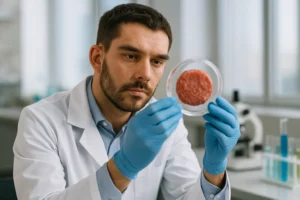
Lab-grown meat is not made from plants or artificial ingredients. Instead, it is created directly from animal cells. A small sample of cells is taken from a living animal – usually through a harmless biopsy – and then placed in a special nutrient solution. Inside a controlled environment, these cells are fed, divided, and formed into muscle tissue. The result is real meat that has never required an animal to be killed. The process was first developed by scientists in the early 2000s, and the first lab-grown burger was produced in 2013 in the Netherlands.
Since then, the technology has advanced rapidly. The cost of producing cultured meat has dropped from $300,000 per burger to less than $10 in some prototypes. Companies such as Mosa Meat in Europe, Upside Foods in the US, and Eat Just in Singapore have been investing millions of dollars into making the process faster and more sustainable. In 2020, Singapore became the first country where lab-grown chicken was officially approved for sale. The product was served in a local restaurant – a historic moment that marked the beginning of a new era in food technology.
Supporters of lab-grown meat argue that this innovation could solve many of the problems linked to traditional animal farming. The meat industry is responsible for a large percentage of global greenhouse gas emissions, deforestation, and water use. Millions of animals are raised and slaughtered every year to meet the world’s demand for meat. In contrast, cultured meat requires less land, less water, and produces far fewer emissions. It can also be produced locally, reducing the need for transport and storage.
However, lab-grown meat is not without controversy. Some critics say it still depends on animal cells and cannot be considered truly “animal-free.” Others argue that it may be too expensive or unfamiliar for consumers to accept on a large scale. Nutrition experts are also debating whether lab-grown meat will offer the same nutrients and taste as traditional meat. Early tastings have shown positive results – many testers reported that the flavor and texture were surprisingly similar to the real thing – but large-scale production and long-term health studies are still being developed.
Another question is psychological. Food is more than just nutrition; it is culture, tradition, and emotion. People’s habits and memories are connected to the way food is grown, prepared, and shared. Replacing something so deeply rooted with laboratory products may take time. Experts believe that education, transparency, and clear communication will be essential if consumers are to trust and accept these new foods.
Still, the potential benefits are enormous. If lab-grown meat becomes widely available, it could reduce the environmental impact of farming, improve animal welfare, and help feed billions of people more sustainably. It will not replace traditional meat overnight – but as technology continues to evolve, a more balanced food system is being built, one plate at a time.